
WhatsApp Channel Join Now
Telegram Group Join Now
1) Brief Background: civilisation and script
Key terms
- Script: written signs used to record a language.
- Bilingual: same text in two scripts/languages; crucial for decoding.
- Undeciphered: we do not yet know how to read it.
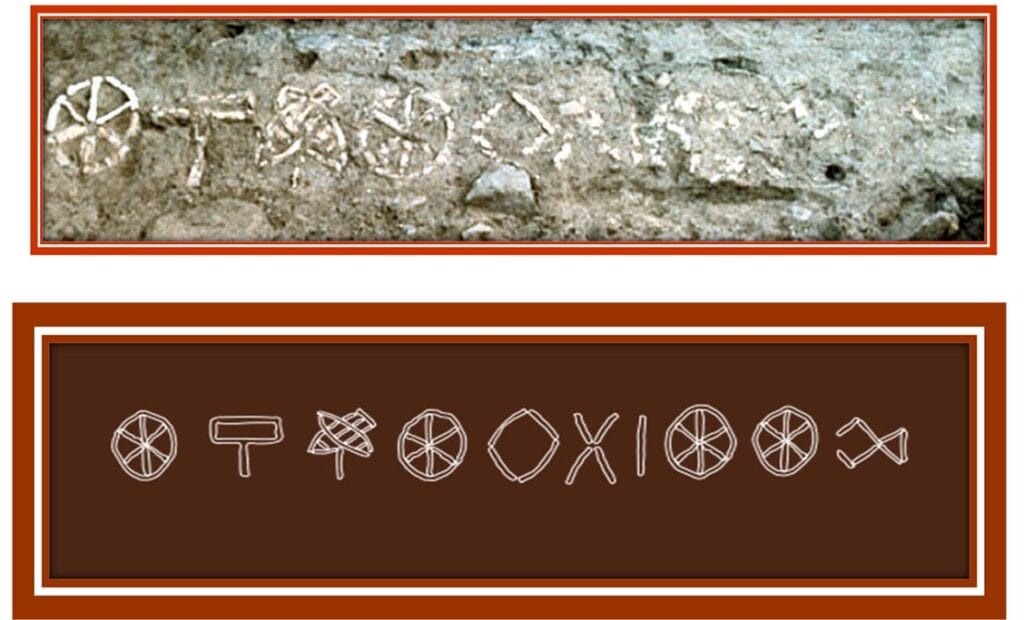
Dholavira Signboard
2) What language could it be? (the big ideas)
Scholars do not agree on anyone theory, and each theory has gaps.
- Proto-Dravidian hypothesis: Many argue the underlying speech was early Dravidian (based on place-name clues, agricultural terms, and some sign patterns).
- Early Indo-Aryan view: A minority links it to early Indo-Aryan, but most linguists find the dating and evidence weak so far.
- Munda/other local family: Some suggest Austroasiatic (Munda) or a lost local family.
- Not a true script? A controversial view says the signs were non-linguistic symbols (identity/ritual). Others counter that sign order behaves like language in statistical tests.
3) Latest developments and debates (why it is back in the news)
- Fresh pushes to decode: New meetings, better imaging, and open challenges have revived interest.
- Prize announcements and public calls: Rewards for rigorous, testable decipherments have brought new teams and methods.
- Peninsular “graffiti” marks: Researchers note visual overlaps between some Indus signs and early graffiti on South Indian pottery. Caution: similarity may show contact or influence, not necessarily that the Harappan language was Tamil.

4) Science can help—but only so far
- Ancient DNA: Tells us about ancestry and population movement, not the spoken language.
- Computational analyses: Show the sign sequences have patterns similar to written text, but this cannot give a direct sound/value for signs or translate words.
5) Why it remains undeciphered (the hard problems)
- Tiny inscriptions and few long repeats → hard to find grammar.
- No bilingual text → no fixed sign-to-sound mapping.
- Many languages in a vast region → even a correct reading might cover only part of the civilisation.
- Un-testable “solutions” → proposals must make clear predictions that others can check.
6) What to watch next
- Better corpora: High-quality photos, 3-D scans, clean sign lists.
- Context-first archaeology: Link inscriptions to find-spots, trade goods, weights, and layers to guess function (ownership, tax, ritual).
- Careful comparisons: Check South Asian graffiti and other scripts with strict methods to separate influence from descent.
- Open, peer-reviewed tests: Any claim should be replicable, handle new finds, and predict readings others can verify.
One-line wrap: We still cannot read the Harappan script; the best-supported possibilities remain Proto-Dravidian or a related local family, but only a bilingual text or longer, well-contextualised finds, tested openly, will finally settle the language debate.



Start Yours at Ajmal IAS – with Mentorship StrategyDisciplineClarityResults that Drives Success
Your dream deserves this moment — begin it here.