
1) Why this is in the news
What this basically means
- India gets easier access to rich, stable markets in Europe for many goods and services.
- EFTA firms get a large, growing market and a clear policy path to invest in India.
- Unlike many past trade deals, this one links market opening with measurable outcomes in investment and employment.
Numbers to remember (for quick recall)
- Investment and jobs pledge: around 100 billion US dollars over 15 years, and about 10 lakh (1 million) direct jobs targeted in India.
- Tariff coverage (broad picture): EFTA reduces duties on over 90% of its tariff lines (covering almost all of India’s current exports to EFTA). India cuts duties on over 80% of tariff lines while protecting sensitive items (for example, gold).
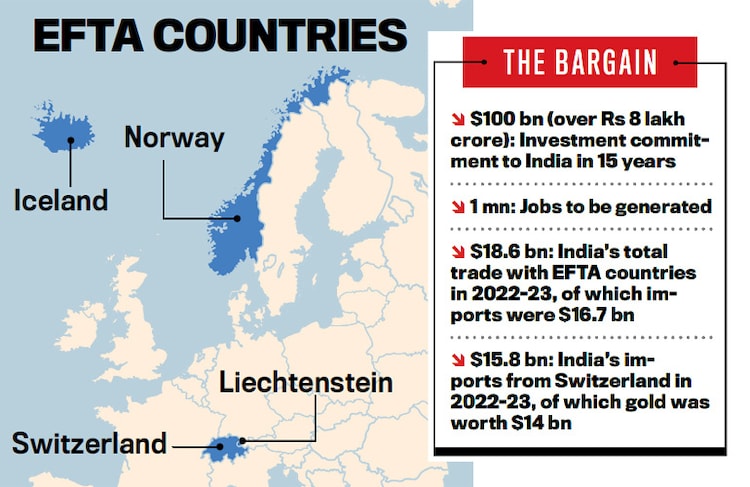
EFTA Countries
2) Who EFTA is, and what TEPA actually covers (beyond “free trade”)
EFTA is a small but very high-income group. Its companies are strong in precision engineering, medical devices, chemicals, clean energy equipment, shipping, finance, and niche technologies. Because average tariffs in EFTA are already low, the real value lies in stable access, quality recognition, and investment partnerships.
What is inside TEPA
- Goods: Lower or zero duties on a wide basket; clear rules of origin (evidence that a product is truly from India or EFTA).
- Services: Space for information technology, engineering design, finance, consulting, and maintenance contracts to grow.
- Investment promotion: A joint framework to mobilise large capital into Indian manufacturing and services.
- Standards and quality: Work together on testing, certification, and technical norms, so Indian products face fewer roadblocks.
- Sustainable development and competition: Modern best-practice chapters that make business more predictable.
Why this design helps India
- It pushes Indian firms towards higher quality and value addition.
- It brings technology, process know-how, and global buyers into Indian clusters.
- It creates a steady pipeline of projects and jobs instead of only tariff headlines.
3) The headline promise: investment and jobs
The most striking feature is the quantified, time-bound commitment: 100 billion US dollars of investment aimed over 15 years, and 10 lakh direct jobs in India. This is to be monitored through joint mechanisms—not left to vague expectations.
Why this is different and important
- It matches India’s goals of “Make in India” and moving up the value chain.
- It can bring labs, pilot plants, clean-tech assembly lines, medical-device manufacturing, and specialty chemicals into India.
- The jobs target gives a clear yardstick: if investments are not translating into factories and employment, course corrections can be made early.
Where the money may go (likely areas)
- Manufacturing and research: medical devices, life sciences, electronics components, precision engineering, clean energy hardware.
- Quality infrastructure: testing labs, calibration centres, certification bodies that are recognised by European buyers.
- Logistics and services: cold chains, warehousing, ports, design studios, after-sales service hubs.
4) Today’s trade baseline—and future projections
It is helpful to know where we are starting from.
Baseline picture (goods)
- Two-way India–EFTA trade in goods has typically been in the roughly 18–24 billion US dollars range in recent years.
- Switzerland is the largest EFTA partner for India. A large part of bilateral value is gold (refined in Switzerland, imported by India).
- Norway–India merchandise trade is modest but strategic (shipping, energy, fisheries-related items). Iceland and Liechtenstein are small but high-income markets.
What can change with TEPA (reasonable expectations)
- If Indian firms use the tariff cuts and meet standards, non-gold exports to EFTA can realistically rise by 30–50% over 3–5 years. This is not automatic; it needs hand-holding on quality and documentation.
- EFTA exports to India should also increase as India lowers duties on many industrial inputs and equipment.
- The net trade balance will depend on two moving parts:
- whether India can scale value-added exports (for example, medical devices, formulations, engineering goods, processed food), and
- how gold imports behave (India has kept gold as a sensitive item, but Switzerland remains a major source, so vigilance is needed).
5) Likely gains—and the risks to manage
Potential gains for India (if we execute well)
- Export push in pharmaceutical formulations, medical devices, engineering goods, textiles and apparel, leather products, processed food, and finished jewellery.
- Technology and quality spillovers: Working to EFTA standards improves testing, traceability, cleanliness, and safety—skills that help in all markets.
- Supply-chain resilience: More buyers and routes reduce dependence on any single country.
- Services opening: Contracts for information technology, design, finance, consulting, and equipment maintenance can expand, helping India’s young workforce.
Key risks and how to handle them
- Gold effect on the deficit: Even with protection, gold inflows can swing the current account.
What to do: keep a close watch on gold imports, encourage domestic refining and value addition, and grow non-gold exports faster. - Standards and cost burden for small firms: Micro, small and medium enterprises may struggle with testing, certification, sustainability norms.
What to do: subsidise lab testing, create shared certification centres, and publish simple compliance checklists. - Uneven spread of benefits: Investment may cluster in a few advanced states and sectors.
What to do: link incentives to tier-2 and tier-3 cities, and labour-absorbing industries; build supplier networks in the East and North-East. - From pledge to projects: Announcements alone do not create jobs.
What to do: set up an annual pipeline review—how many projects approved, how many started, how many jobs created; fix bottlenecks quickly.
6) What India should do now
A. Make the rules simple and visible
- Publish plain-English tariff booklets and a Rules of Origin explainer with examples (what counts as “made in India”).
- Issue sector guides for medical devices, chemicals, food processing, engineering, showing required standards and documents.
B. Hand-hold exporters and small firms
- Run exporter bootcamps on EFTA standards, packing, labelling, and sustainability reporting.
- Offer vouchers or reimbursements for testing and certification at approved labs.
C. Fast-track investment and spread it
- Create a TEPA Investment Dashboard that tracks projects state-wise, with single-window clearances and time-bound approvals for factories, labs, and logistics parks.
- Tie production incentives, credit, and skilling to setting up in labour-surplus regions and new clusters.
D. Build quality and recognition
- Expand testing labs and accreditation bodies that are recognised by European buyers; work towards mutual recognition to reduce duplicate testing.
- Encourage industry–academia centres for precision manufacturing and clean technologies.
E. Use the services window
- Through the joint committees, push digital trade, design-as-a-service, clean-tech maintenance, and financial-services niches where Indian talent can scale quickly.
F. Monitor and publish outcomes
- Each year, publish simple dashboards: investment inflows, projects started, direct jobs, non-gold export growth, share of micro, small and medium enterprises in new contracts. This creates public accountability and confidence.
Mains Practice (200–250 words)
“India–EFTA TEPA links market access to a quantified investment-and-jobs pledge. Using today’s trade baseline and the tariff-coverage design, explain how India can convert TEPA into higher non-gold exports and quality employment while managing the current account risk.”
Hints: Begin with who EFTA is and what is new in TEPA (investment + jobs). State the baseline (two-way goods trade roughly 18–24 billion US dollars; gold is large in value). Explain how tariff cuts plus standards work can raise non-gold exports by 30–50% over 3–5 years if we hand-hold firms. List risks (gold-led deficit, standards burden, uneven spread, pledge-to-project gap) and give fixes (testing labs and mutual recognition, exporter bootcamps, TEPA investment dashboard, incentives for tier-2 clusters, annual public tracking). Conclude that the real success is factories, labs, and steady jobs—not just tariff tables.
One-line wrap
Open the door—and walk through it: turn TEPA’s market opening and 100-billion-dollar window into factories, quality exports, and jobs, while hand-holding small firms and keeping an eye on the gold–deficit risk.



Start Yours at Ajmal IAS – with Mentorship StrategyDisciplineClarityResults that Drives Success
Your dream deserves this moment — begin it here.