
Why in the news?
Fresh violence and displacement reported from parts of Manipur in February 2026 have once again exposed the deep ethnic and political fault lines in the State, raising concerns about long-term stability and social cohesion.
A society divided by history
- Manipur is home to three major social groups – Meiteis, Nagas, and Kuki-Zo tribes – who have historically lived separate social, cultural, and political lives.
- Though Manipur was once a kingdom, it never fully integrated the hill areas through conquest or administrative control.
- The hills remained largely autonomous until the Maharaja entered into a subsidiary alliance with the East India Company in 1762 and later under British rule from 1824.
- As a result, no strong historical bonding developed between the valley-based Meiteis and the hill tribes.
Religion, identity, and separation
- Social practices such as untouchability widened the gap between Meitei Hindus and tribal communities.
- In the late nineteenth century, Christian missionaries introduced modern education among hill tribes.
- Gradual adoption of Christianity by Nagas and Kuki-Zo groups added a religious dimension to ethnic separation.
- Over time, each community evolved its own worldview, institutions, and political aspirations.
Conflicting political aspirations
- Meitei groups: Sections seek greater autonomy or even an independent Manipur nation.
- Tribal communities: Many aspire for separate homelands or administrative arrangements.
- These competing visions make compromise difficult and intensify mistrust.
Recent trigger, deeper causes
- The February 7, 2026 incident in Litan reportedly began as a local altercation, but quickly acquired an ethnic colour.
- Social media narratives, rumours, and past grievances helped escalate a minor incident into large-scale violence and displacement.
- The event highlighted how routine conflicts are quickly communalised in Manipur’s tense social environment.
Widening fault lines
- After the major Meitei–Kuki-Zo clashes of May 2023, new tensions appear to be emerging:
- Between Tangkhuls and Kuki-Zo groups
- Earlier frictions involving Zeliangrong communities
- Such multi-front tensions risk pushing the State into permanent instability.
Human cost and governance challenge
- The worst affected are always civilians – children, women, and the elderly.
- Frequent deployment of security forces may control violence temporarily but cannot heal social fractures.
- Lack of trust in institutions and perceived bias further deepen alienation.
Key terms explained
- Ethnic fault line: A deep social division based on identity, culture, or origin that can trigger conflict.
- Subsidiary alliance: An agreement where an Indian ruler accepted British military support in return for political control.
- Communalisation of conflict: Interpreting incidents through an ethnic or religious lens rather than as individual acts.
- Internal displacement: Forced movement of people within a country due to violence or insecurity.
- Social cohesion: The ability of diverse groups to coexist peacefully within a society.
Way forward
- Political dialogue across communities, not selective engagement.
- Impartial governance and restoration of faith in administration.
- Long-term reconciliation, including truth-telling, community mediation, and inclusive development.
- Recognition that peace cannot be imposed only through force, but must be built through trust.
One-line wrap
Manipur’s recurring violence is not the result of isolated incidents, but the outcome of unresolved historical divisions, competing identities, and fragile governance.
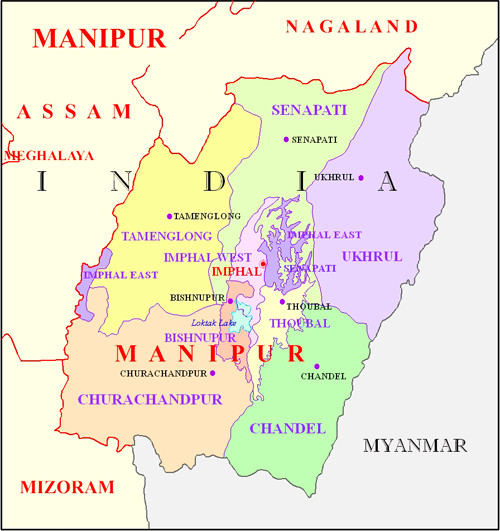
Assam-Manipur
Two districts of Assam shared a boundary with Manipur.
- Dima Hasao-Manipur – 73.50 Km
- Cachar-Manipur- 130.60 Km
Manipur has a total of 16 districts of which 3 districts share a border with Assam.
Exam Hook –
“Manipur’s ethnic conflicts are rooted more in historical separation than contemporary politics.” Discuss, highlighting the challenges for internal security and national integration.



Start Yours at Ajmal IAS – with Mentorship StrategyDisciplineClarityResults that Drives Success
Your dream deserves this moment — begin it here.