

Syllabus: GS-III & V: Agriculture
Why in the News?
Despite the high and growing demand for flowers for household and commercial use, commercial floriculture remains underdeveloped in Assam, restricted to a few pockets like Hajo, Rangia, Morigaon, Nagaon, Dibrugarh, and Jorhat.
More About the News
Farmers, particularly those from the traditional flower-growing belt of Hajo in Kamrup district, have repeatedly highlighted the critical lack of a permanent, organised market space in Guwahati, forcing them into pre-dawn, unorganized sales and exploitation by middlemen. This issue brings the economic and infrastructural constraints on Assam’s high-value agriculture into sharp focus.
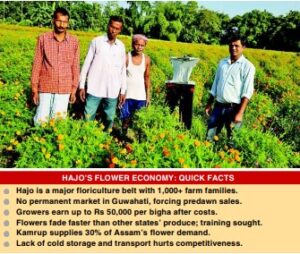
Immense Potential and Current Economic Impact
Assam, with its favourable agro-climatic conditions and rich floral biodiversity (including 191 species of indigenous orchids), is naturally positioned for a floriculture boom.
- High Profitability: Floriculture is an intensive, high-value agriculture sector. Growers in Hajo report realizing profits up to ₹50,000 per bigha (excluding input costs of ₹15,000–20,000 per bigha), significantly higher than traditional crop returns.
- Guwahati’s Demand: Kamrup district, mainly Hajo and Rangia revenue circles, currently meets about 30 per cent of the state’s flower demand, which is largely temple- and shrine-centric, besides expanding urban ceremonies.
- Import Dependence: Despite this potential, Assam imports flowers worth ₹8–10 crore annually from neighbouring states, particularly West Bengal (like Kolkata), due to low internal production consistency and lack of quality infrastructure.
- The state’s total area under floriculture is currently less than 1 per cent of its agricultural land.
- FPO-led Initiative: Farmers are now organized under bodies like the Indramalati Agro Producers Company Limited (FPC), a Farmer Producer Organisation, which aims to provide backward (inputs, training) and forward (marketing, cold storage) linkages, showing a move towards corporatisation and better farm management.
Challenges Faced by Growers
The transition from hobby horticulture to a sustainable commercial industry is severely hampered by major infrastructural and technical gaps:
- Lack of Organised Market: This is the most pressing problem. The absence of a permanent market shed in Guwahati (such as those previously requested near Sukreswar Ghat, Fancy Bazar, or Bharalu) forces farmers into predawn, temporary selling spaces, leading to price manipulation by middlemen and substantial losses, especially during the rainy season.
- Poor Post-Harvest Management: Assam’s flowers reportedly fade faster compared to those imported from other states.
- This is a direct consequence of the lack of cold storage facilities, small-scale cold-chain logistics, and refrigerated transport, which are essential for preserving the freshness, colour, and fragrance of perishable flowers and competing with imports.
- Technological Gaps: Production in Hajo is largely unorganised. Farmers lag behind in adopting modern practices such as protected cultivation (using polyhouses or shade-net houses), which can significantly boost productivity, ensure year-round production, and protect crops from adverse weather.
- Skill Deficit: Farmers have requested advanced training outside the state to adopt better production techniques, handle high-value cut flowers (like Gladiolus, Gerbera, Anthurium, and Orchids), and improve post-harvest handling methods.
Government Schemes and Intervention
The development of floriculture is supported by both central and state government initiatives, which must be leveraged effectively:
- Mission for Integrated Development of Horticulture (MIDH): This is a Centrally Sponsored Scheme that provides assistance for the holistic growth of the horticulture sector, including floriculture.
- Key components relevant to Assam include the promotion of protected cultivation (polyhouses), creation of water resource structures, and support for post-harvest management and marketing infrastructure.
- Chief Minister’s Floriculture Mission (Assam): A dedicated state-level scheme aimed at the all-round development of the floriculture sector, providing planting materials, shade nets, technical support, and training.
- Government Support: The Kamrup Agriculture and Horticulture departments already provide high-quality seedlings (marigold, tuberose, gerbera), along with farm equipment like sprayers, power tillers, and polyhouses.
Way Forward:
- Dedicated Flower Mandi: The highest priority must be the establishment of a dedicated, permanent wholesale market complex in Guwahati, equipped with basic sorting, grading, and cold storage facilities.
- Micro-Cold Chains: Promotion of small-scale, decentralized pre-cooling units and refrigerated micro-transport should be subsidized under schemes like MIDH to extend the shelf life of local flowers and improve competitiveness against imports.
- Protected Cultivation Clusters: Focused schemes should promote the establishment of polyhouse clusters for high-value cut flowers in areas like Hajo, ensuring year-round supply and meeting high-quality standards.
- FPO Strengthening: Providing financial and technical assistance to Indramalati Agro Producers Company Limited and other FPOs will enhance their capacity to provide inputs, collective marketing, and training, thereby reducing the role of middlemen.
Exam hook: Key Takeaways
- Potential vs. Reality: Assam has high potential for floriculture due to favourable climate but commercial output is low (< 1% of India’s floriculture area).
- Primary Constraint: Lack of permanent, organised market infrastructure in Guwahati and poor post-harvest management (cold storage/transport) leading to spoilage and low farmer returns.
- Solutions: Leverage MIDH (Mission for Integrated Development of Horticulture) and state missions to create dedicated flower mandis and establish protected cultivation (polyhouses) and cold-chain logistics.
Mains Question:
“Discuss the potential of floriculture to diversify farm income and address rural unemployment in Assam. What specific post-harvest management and marketing infrastructure interventions are required to transform traditional flower-growing belts like Hajo into organized commercial clusters?”
Share This Story, Choose Your Platform!
Start Yours at Ajmal IAS – with Mentorship StrategyDisciplineClarityResults that Drives Success
Your dream deserves this moment — begin it here.